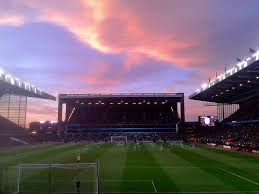
Aston Villa took the footballing world by storm last season as they booked a place in their first Champions League since 1983 (then known as the European Cup). However, it’s over the past two seasons that Unai Emery has worked his wonders. Taking over from Steven Gerrard in the Autumn of 2022, the Lions leaped the table from 14th to 7th, booking a place in Europe.
Villa Park has well and truly become a fortress. Throughout his tenure, they have won seventy-one points out of a possible ninety-nine (thirty-three games) at Villa Park. To put it into perspective over the last thirty-three home games, just Man City, Liverpool, and Arsenal better this (eighty-four, eighty-one and seventy-seven.)
How then, do they sustain this success? Could they become even better?
Unai Emery
The first step is having the correct leader in their camp. We can tick that off. Unai Emery is precisely that. The team that whimpered to a 3-0 loss at Craven Cottage in Steven Gerrard’s final match is unrecognisable from what we see today. Yet when the Villareall boss replaced him, some were underwhelmed.
Perhaps English fans were stained with the memories of his dark days at Arsenal. After missing out on a top-four finish by a single point, Emery was relieved of his duties the following season as things only went downhill. There were grumblings that players had lost the appetite to obey his rigorous demands when there was no positive outcome.
It’s just one dark snapshot far outweighed by his successes over the years. We are talking about a coach who has lifted four Europa League (three with Sevilla and once with Villareal). A coach who has guided the “Yellow Submarine” to a Champions League semi-final. A coach who has now ended the continental drought for the Villa faithful.
Uniqueness
It would be unfair to brush over the Arsenal dressing room’s frustrations. After all, Emery is one of the most unique managers. It’s his way or no way. However, his hands-on approach works wonders at Aston Villa, with his outlook reflected on the playing field.
They have generally used a fluid 4-4-2 formation throughout his time. It’s not quite a traditional two bags of four paired with a target man and poacher. Instead, the left-sided and right-sided midfielder tuck in during the possession phase to create a box in central areas. Therefore, midfielders are in close proximity and can bounce pass easily, thereby creating space. Plus, counter-pressing can be easily achieved to suffocate opponents. It’s up to the front two to create width, particularly the right forward when Ollie Watkins starts.
They also play with one of the highest defensive lines in the league. The plus sides are the ability to squeeze the game to their liking. The downside is that you rely heavily on the offside trap working and the pace of the individual defenders. We saw in a home game against Spurs and away to Newcastle on the opening day that issues that can arise.
Meticulous
Yet, what defines Emery is his adaptability. Despite this 4-4-2 system becoming the hallmark of his Aston Villa side, at Valencia and Arsenal, he preferred a 4-2-3-1. At Villareal, he sometimes utilised a back three in possession. That is to say, he tends to adapt his playing style to the tools at his disposal.
Moreover, the attention to detail he shows his opponents is unrivaled. While some coaches prefer a focus-on-strengths game plan, the characteristics of his opponent are just as vital to the Villa manager. When drawn against a Lee Johnson Hibernian side sitting bottom of the Scottish Premiership in the Conference League Qualifiers, John McGinn revealed that on a stroll down the Bodymoor Health training ground corridor, something caught the corner of his eye.
He peaked in and saw eight coaches sitting around laptops, analysing the patterns of play that the Hibees enjoyed and how to exploit them. This carries over to the players. Hour-long presentations and tactical homework: it’s what those under Emery must endure. While things are working he comes across a genius. During a poor spell such as his Arsenal tenure, the players can become burnt-out and despondent.
Victory over Man City
After such a positive start to last season’s campaign, some were waiting for Aston Villa to slip-up. Many had marked the 6th of December as the date in their diaries: a clash against Pep Guardiola’s Manchester City. Conversely, this strengthened Villa’s case as a genuine title contender and remains their best performance since returning to the Premier League.
It’s not unusual for Manchester City to lose games( as much as it may feel like it.) In their last four titles, they have suffered seventeen defeats (averaging 4.25 times a season). Usually, teams achieve such a feat by sitting in a low block, riding their luck and frustrating the Champions.
However, on a freezing mid-week clash, the league leaders were boiled alive. The score may have been just 1-0, yet it should’ve been a hammering. With twenty-two shots to two, it was a schooling.
We quite often see teams such as Brighton, try to outplay Manchester City and ultimately fall victim to having players of less quality. Yet Emery flexed his adaptability muscles as he found the perfect balance of being aggressive but sensible. This was revealed just three minutes in.
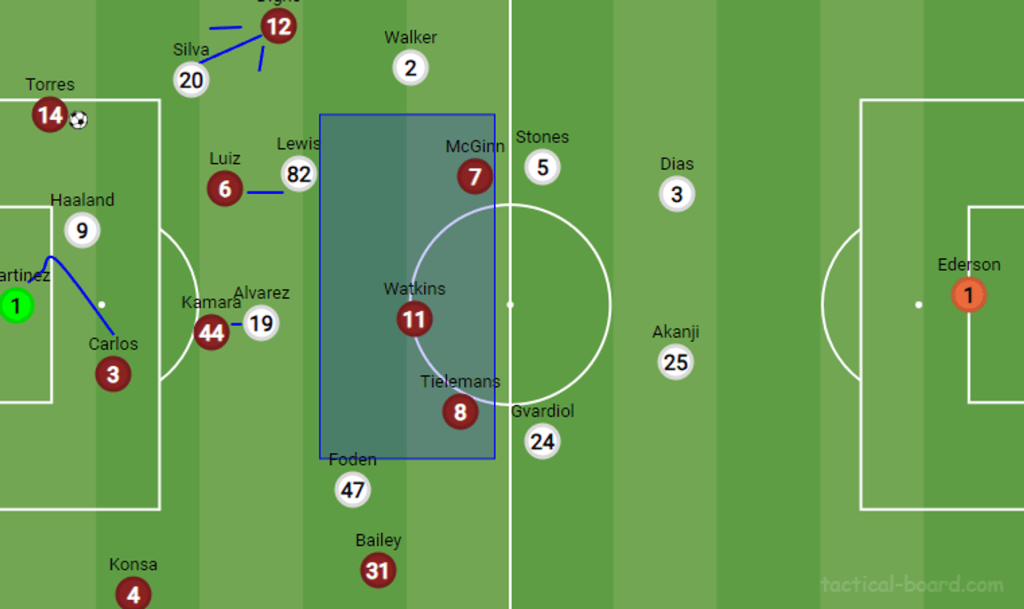
Manchester City pressed aggressively from the off. As Martinez plays to Pau Torres, the Cityzen’s forward line goes for a mix of man-to-man and zonal. Erling Haaland blocks Torres’s ability to return the ball to Martinez or Carlos. Bernando Silva blocks a path to Digne, meanwhile, Alvarez and Lewis go man-to-man on Luiz and Kamara.
Teams such as Brighton or Burnley would try to play through this imposing press and give the ball to Luiz or Kamara, who would either have to do a risky turn to progress or pass straight back to Carlos and then Konsa. Doing that would allow City to shift over and put Konsa under extreme pressure to either take on Foden or clear it long.
Instead, Villa play to their strengths. John Mcginn tucks in, meaning Kyle Walker can’t follow him. Otherwise, too much space would open up on his side. The Scotsman controls the ball and plays a forward pass to the willing runner of Leon Bailey.
Thus, they can skip the press and attack one of Manchester City’s few weaknesses: defending counterattacks.
Plus, it makes City less likely to try and press again as no defenders like to be chasing their own goal constantly. This means that Villa have more space to build up from the back.
It’s just one point, but this example of playing to your strengths and attacking the opponent’s weak points is what makes Emery one of the best in the business.
The home side would dominate, with their rotating forwards so tough to handle.
Arsenal away
Days after beating Man City at home, they repeated the feat as a John McGinn goal saw Arsenal leave Birmingham empty-handed. Even after defeating two title-challenging rivals, they still had their doubters.
There was plenty made of the bizarre line-up Guardiola fielded against Villa as a midfield of John Stones, Manuel Akanji (in possession), Rico Lewis and Julian Alvarez took to the pitch when none were natural midfielders. It was even more baffling as Bernardo Silva and Phil Foden pushed on the wings. No wonder Villa’s midfield could dominate.
Plus, in a victory against Arsenal, there was a contentious decision that saw a Kai Havertz goal ruled out to deny the visitors a point.
Perhaps the most impressive tactical performance of any side this season was Aston Villa’s away to Arsenal.
There was a buzz in the air at the Emirates. Title rivals Liverpool had just suffered a shock loss to Crystal Palace at home. Arteta’s side had a chance to punish them. Heading into this clash they were the in-from side, winning ten of their last eleven league games, drawing just one.
The bravery of the Villa side was a sight to behold. Sure, they had to ride their luck with Emi Martinez pulling off some world-class saves, but their game both in and out of possession, was faultless.
Out of possession, they played a flat 4-4-2 midblock. It was similar to the system that Porto utilised which frustrated Arsenal in the Champions League. This afforded the home side little space, and to create chances the football had to be perfect.
In possession, they used Emi Martinez to great effect. The Argentinian took 66 touches and in build up they played their usual 4-2-2-2. This extra man in possession stopped Arsenal from going man-to-man and allowed Villa to cut through their world-class press like a knife through hot butter.
By the time the second half was in full flow, Arsenal began to flounder as the visitors looked the more dangerous. Goals from Bailey and Watkins were enough to record a famous victory which cemented Aston Villa’s Champions League ambitions and struck a blow to Arsenal’s title charge.
Transfer Business
Outgoings
| Player | Club | Position | Age |
| Moussa Diaby | Al-Ittihad | RW | £55 million |
| Douglas Luis | Juventus | CM | £45 million |
| Tim Iroeguman | Everton | CM | £10 million |
| Morgan Sanson | Nice | CM | £4 million |
| Sinsalo | Celtic | GK | £1.2 million |
| Duran (likely) | West Ham | ST | £30 million |
Incomings
| Player | Club | Position | Age |
| Amadou Onana | Everton | CDM | £56 million |
| Ian Maatsen | Chelsea | LB | £39 million |
| Cameron Archer(obligated buy back) | Sheff UTD | ST | £15 million |
| Jaden Philogene | Hull | LW | £13 million |
| Samuel Iling – Junior | Juventus | LW | £13 million |
| Lewis Dobbin | Everton | LW | £11.8 million |
| Enzo Barrenchea | Juventus | CDM | £7 million |
| Ross Barkley | Luton | CM | £4.5 million |
They have been one of the most aggressive in an uncharacteristically quiet window. With the new PSR rules in place, this is hardly a surprise. At first glance, the sales of Moussa Diaby and Douglas Luiz seem quite risky as both played a major role in last season’s exploits.
Yet you could argue it’s also the sign of a well-run club. To adapt and reach the top, sometimes star figures leave. In the Winter of 2018, when Philippe Coutinho joined Barcelona, many worried that Liverpool would struggle after losing such a creative force. Instead, they re-invested the money in first-team signings such as Alisson, Virgil-Van Dijk and Fabinho and made great strides.
Amadou Onana and Ian Maatsen both signed last month for a combination of around £85 million. Onana is a slightly different style of player than Luiz. The Belgian is less comfortable in possession but has more physical presence and provides more stability. What they lose in attacking ability can be made up by Maatsen. The left-back played a colossal role in Dortmund’s run to the Champions League final and will look to get forward whenever possible, providing width on the left-hand side that was arguably missing at times last campaign.
Moreover, the likes of Phiogene, Junior, Dobbin, Barrenchea and Barkley will provide some much-needed depth. Last season Emery largely relied on a select few to continuously churn out performances. More quality options will be necessary, especially with Champions League football on the horizon.
The hard step
“”The feel-good story” was what they were often branded last season. Let’s not forget we’ve seen this script before.
Despite the six dynasties that power over English football having it mostly their own way, we often see a breakout team. This is nothing new. Roberto De Zerbi’s Brighton in 2022/23 finished in sixth. David Moyes’ West Ham during 2020/21 and 2021/22 finished sixth, seventh and won the Europa Conference League. Finally, there was Brendan Rodgers’ Leicester team – arguably the best of either side in this category – who lifted the FA Cup, got to the Conference League semi-final and recorded two fifth-place finishes.
In terms of what comes this season, consolidation should be the aim. Of course, that is easier said than done. However, competing with the established top dogs once more would be no mean feat.
As Unai Emery will say next week, it’s one game at a time. First up for Villa is a trip to the London Stadium.



 Beyond The Score
Leave a comment