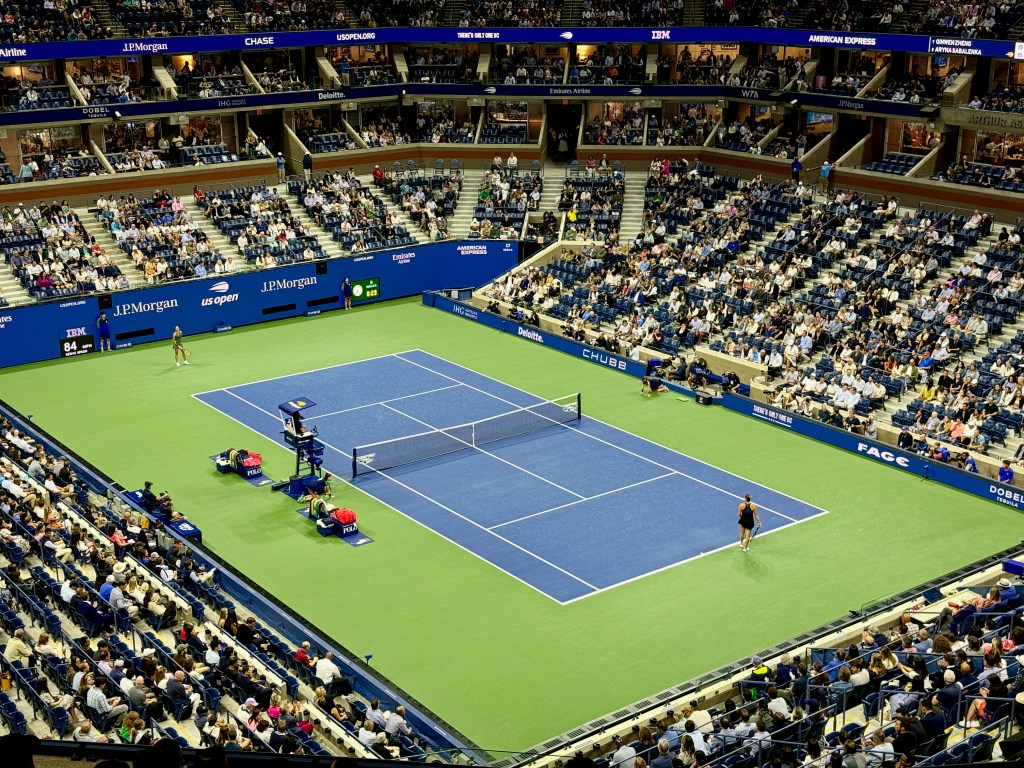
After two tiebreaks and over two hours, Matteo Berrettini walked off court cutting a rather chuffed figure having booked a place in the semi-finals against world number#12 Stefanos Tsitsipas after defeating Felix Auger-Aliassime.
There was a wonderful symmetry about this match in a way. After all, it’s two men who fight desperately to rediscover the world-class form they showed in the past few years. Berrettini has suffered a torrid time with injuries since the 2021 season which saw him reach a career high ranking of #6 in the world. That season he reached two Grand Slam quarter finals and earned a runners up medal at Wimbledon.
Auger-Aliassime never got to the hefty heights on the grand slam stage but proved a tough man to beat week in and week out on the tour. Sure a run starting in 2021 which stretched to 2022 saw him make two quarter finals and a semi finals inside three grand slams, but it was the four tour level titles which got him his career high ranking of… You guess it, #6 in the world.
The period after for both men would be plagued with poor form and injuries which hampered their ability to compete at the level they showed themselves capable of.
In recent times though, things have looked more positive. Auger-Aliassime has put together some consistent victories to propel himself back in to the world’s top 20 meanwhile Berrettini’s performance levels have began to resemble more the player which forehand and serve was enough to give any player in the world of tennis a severe headache.
The Opening Set
This was always bound to be a fascinating game from a tactical perspective as the game styles of the two contrast so greatly. Berrettini is what one may regard the “agricultural” tennis player. He plays to his strengths with his monstrous forehand and massive serve and aims to out-power whoever stands at the other side of the net. Auger-Aliassime in contrast doesn’t possess any real weapon. Instead, he is solid in all areas. It’s why in 2021 and 2022 he was able to be so consistent and was a banker to make the deep stages at every tournament, he was mister reliable. Although admittedly one with a ceiling. For the Canadian to excel he has to play smart tennis and pick apart his opponent’s game, whereas the Italian just seems to be more effortless.
Either way it was a closely fought start and truly a sign of things to come. The slice backhand of Berretinni seemed to be effective in restricting the spin that Auger-Alliasime could generate and often it lead to a inside out forehand being laid for the former on a plate.
Both men were serving incredibly well. The out wide serve on the advantage court was the go-to option (unsurprising on a high bouncing clay court of course). By the end of the first set both had won 70% of their first service points. There was one pattern though that was quite interesting, and it comes in the shape of rally length. In rallies above nine shots Auger-Aliassime was winning 64% of the points. Berrettini tried to shorten the points and come to the net to prevent drawn out exchanges but was wining only 40% of his net points and got passed eight times.
With two patterns working in each other’s favour the set came down to a tiebreak and it was Berrettini who was able to remain calm and collected and win by nine points to seven.
The Closing Set
Despite another set going to a tiebreak the second set was truly a different story. One player changed their strategy and got worse while the other kept to their plan but improved. Auger-Aliassime began to play a more aggressive game. This was slightly surprising as in the previous set he was getting his joy from the longer more conserved rallies. However, this trend changed as Berrettini would win 83% of rallies that consisted of more than nine shots, an increase of 37%. There was also more inconsistency from the Canadian as although he scored four aces that came with four double faults.
This is when we see the difference between good and great players. The ability to move up the gears without sacrificing reliability. The world number #82 would also improve at the net winning 67% of those points. Where a great deal of credit must be given though is for his return game. Due to the slice backhand he so often uses to mask a weak two hander, it means that the chip return comes so much easier to him.
It’s little surprise then that come the tiebreak the former Wimbledon runner up was much more solid and won rather easily by seven points to two.
What this means for Auger-Aliassime
By no means was this a result to be ashamed of however, there were some worrying patterns. A player who has often been criticised for showing a lack of nerves in recent years (he lost his first eight finals) was unable to convert at the big moments again. Tennis is a game of fine margins and often just a couple of points can be crucial in deciding it. When a tiebreak arrives all that came previously goes out the window.
As it stands Auger-Alliasime is on no entry list for either clay event next week, therefore he will head back to Paris to compete in the prestigious Olympic games for Canada, flying the flag with Milos Raonic in both the singles and doubles.
A break from the main tour and the constant pressure of ranking points may be what the doctor orders for a man who does seem to be rediscovering his form.
What this means for Berrettini
Next up is Stefanos Tsitsipas. On a grass or hard court you would honestly favour the Italian. Since last year’s Australian Open Final Tsitsipas hasn’t found any real form out with the clay. However this season’s Monte-Carlo champion is still one of the top dog’s on the dirt and will likely go through without too much complication. Heartbreakingly for Berrettini he won’t be taking part in this year’s Olympic games in Paris, although he could maybe use that as fuel to surge back up the rankings.



 Beyond The Score
Leave a comment